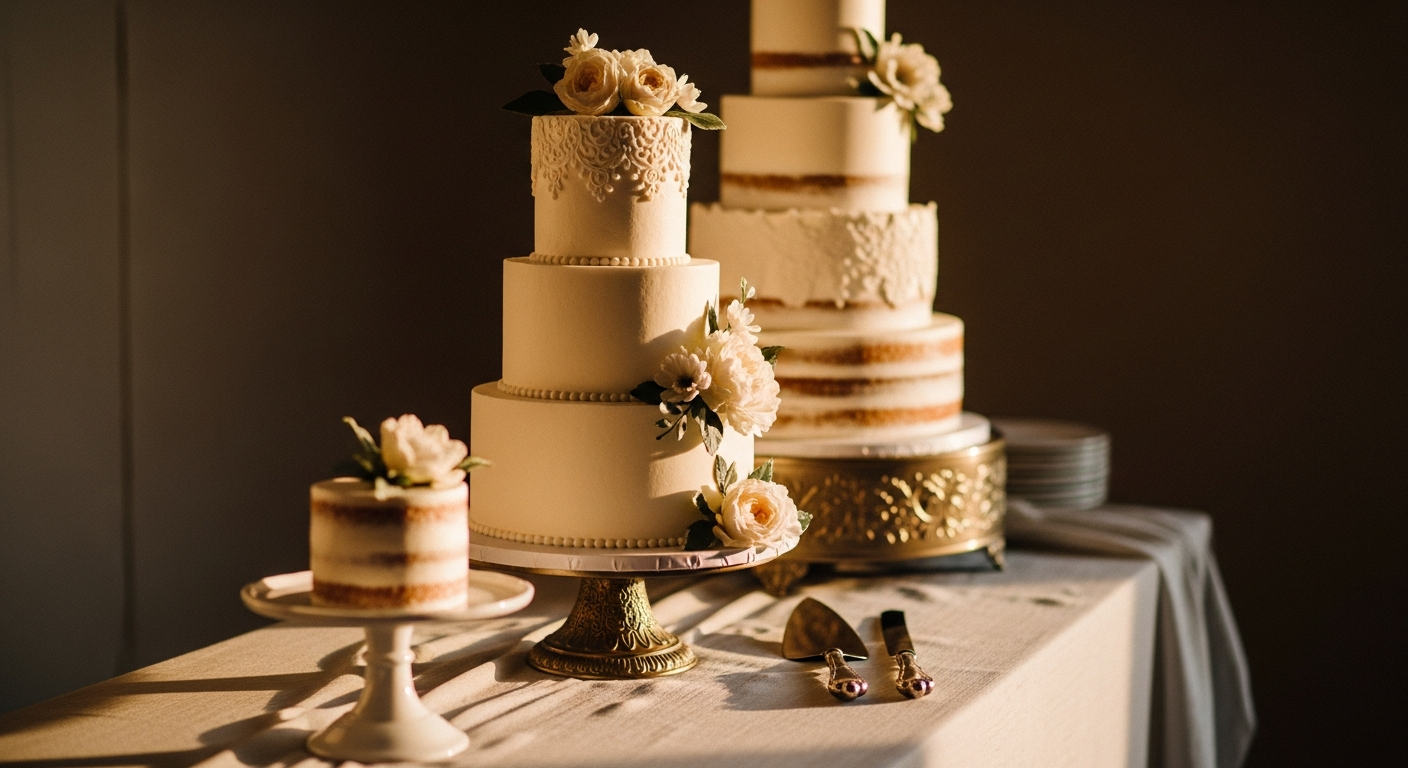
Wedding Cake Size Chart by Guest Count: The Complete Guide to Getting Your Portions Right
Use our wedding cake size chart by guest count to order the perfect cake. Includes serving calculators, tier dimensions, and expert sizing tips.
Ryan O'Sullivan
Ordering too little cake is one of the most stressful wedding day surprises — and ordering too much means wasting hundreds of dollars. Getting the size exactly right depends on more than just your headcount. Your serving style, tier configuration, and even the time of day all play a role. This guide gives you a wedding cake size chart by guest count, practical sizing math, and real-world troubleshooting so you can walk into your baker consultation fully prepared.
Why Guest Count Alone Isn't Enough
Most couples assume wedding cake sizing is simple: count your guests, find a number, and you're done. But experienced bakers will tell you that a wedding for 100 guests at a formal seated dinner requires a very different cake than a 100-person cake-and-punch afternoon reception. Before you consult any wedding cake size chart by guest count, you need to answer three key questions:
- Is the cake the primary dessert, or one of many? At a full dessert station with pies, macarons, and cookies, guests eat smaller slices. If the cake stands alone, plan for generous portions.
- What time is your reception? Evening receptions see more cake consumption than midday events. Hunger levels and formality shift expectations.
- Do you want leftovers, or will every slice be served? Some couples intentionally order a slightly larger cake to save a top tier and have leftovers; others cut it close to minimize cost.
The Standard Wedding Cake Serving Chart
The industry standard for a wedding cake portion is approximately 1" wide x 2" deep x 4" tall — a modest but satisfying slice. Here's how common round tier sizes break down by serving count:
| Tier Diameter | Approx. Servings (Standard) |
|---|---|
| 6" round | 10–12 servings |
| 8" round | 20–24 servings |
| 10" round | 35–40 servings |
| 12" round | 50–56 servings |
| 14" round | 65–78 servings |
| 16" round | 90–100 servings |
Square tiers yield roughly 25–30% more servings per diameter because of the additional corner geometry. A 10" square, for example, yields approximately 50 servings versus 38 for a 10" round.
Wedding Cake Size Chart by Guest Count: Recommended Configurations
Here's a practical wedding cake size chart by guest count that maps common guest totals to typical tier combinations:
50 guests: Two-tier cake — 8" + 6" (serves 30–36). Add a small sheet cake in the kitchen for extra servings if needed.
75 guests: Two-tier or three-tier — 10" + 8" (serves 55–64) or 10" + 8" + 6" (serves 65–76).
100 guests: Three-tier — 12" + 10" + 8" (serves 105–120). This is the classic wedding cake configuration.
150 guests: Three-tier large or four-tier — 14" + 12" + 10" + 8" (serves 170–198). Perfect for a statement cake that still feeds everyone comfortably.
200 guests: Four-tier — 16" + 14" + 12" + 10" (serves 240–274). At this scale, consider whether a supplemental sheet cake in the kitchen cuts cost without affecting the visual presentation.
250+ guests: Five-tier or main cake plus supplemental sheet cakes. A 14" + 12" + 10" + 8" + 6" five-tier serves approximately 230–265. Supplemental kitchen cakes are almost always recommended at this size.
Dummy Tiers and Display Cakes: The Visual Trick You Should Know
Many couples want an impressively tall, architecturally dramatic cake but don't need 200+ servings. Enter the dummy tier — a foam or styrofoam form covered in fondant that looks identical to a real tier but contains no cake. This is completely standard practice in the industry and nothing to be embarrassed about.
A common configuration for 80 guests wanting a five-tier look: real 12" + real 10" + dummy 8" + real 6" bottom display tier + real 6" top tier. The total servings come from the real tiers only, while the dummy creates height and visual drama.
Always confirm with your baker which tiers are real and which are display — your caterer needs this information to cut and serve correctly.
Serving Style Adjustments: The Multipliers That Change Everything
Cake and punch reception (no full meal): Multiply your guest count by 1.2. Guests will eat more cake when it's the centerpiece of the refreshments.
Full dinner with multiple desserts: Multiply your guest count by 0.7–0.8. Many guests will pass on cake or take smaller pieces.
Children at the wedding: Count children under 12 as 0.5 servings each.
Saving the top tier: Subtract those servings entirely from your available count and size up to compensate.
Dessert bar or donut wall alongside the cake: Reduce your cake serving estimate by 20–30%.
Common Sizing Mistakes (And How to Avoid Them)
Mistake #1: Using a guest list number instead of a confirmed RSVP number. Always base your cake order on final RSVPs, not your invitation list. A 10–15% buffer is reasonable, but sizing for your full invite list when you expect 75% attendance leads to significant over-ordering.
Mistake #2: Forgetting the vendor meals. Your photographer, DJ, coordinator, and other vendors often eat cake too — especially if they're working through dessert. Add 5–10 servings for vendor meals.
Mistake #3: Assuming the baker's serving chart matches your caterer's cutting style. Bakers calculate servings based on their standard portion. Caterers who cut cake sometimes produce larger or smaller pieces depending on their training. Discuss this explicitly and provide your caterer with a written cutting guide.
Mistake #4: Not accounting for a cutting cake. If you want pristine photographs of an uncut display cake, some couples bring a separate small "cutting cake" for the ceremonial slice, then serve from a kitchen sheet cake. This changes your serving math entirely.
Mistake #5: Ordering purely by flavor. If you want three different flavors, resist the urge to order three entirely separate full cakes. A skilled baker can layer different flavors within the same tiered structure.
Using This Guide With Your Baker
Once you know your estimated serving count and preferred configuration, it's time to bring this information to a professional consultation. Bakers who specialize in wedding cakes will help you refine the sizing based on their specific recipes (a denser cake like carrot or red velvet yields slightly different portions than a lighter vanilla sponge) and their preferred construction methods.
If you're still exploring styles — whether you're drawn to something sleek and modern or something warmly textured and rustic — your size and your style decisions will often influence each other. Heavily sculpted or hand-painted cakes sometimes require structural adjustments that affect how tiers are sized.
Not sure what aesthetic direction speaks to you yet? Take our style quiz to get personalized recommendations before your first baker meeting.
When you're ready to find bakers in your area, browse our full directory of wedding cake professionals to connect with specialists who can bring your vision to size — and to life.
Frequently Asked Questions
How many tiers do I need for a 100-person wedding cake?
For 100 guests, a three-tier cake — typically 12", 10", and 8" rounds — is the most common configuration and yields approximately 105–120 standard servings. This gives you a comfortable buffer. If your guest count is exactly 100 with no extras needed, a 12" + 10" two-tier with generous sizing can also work.
What is the standard serving size for a wedding cake?
The wedding industry standard portion is 1" wide by 2" deep by 4" tall. This is smaller than a typical bakery slice but appropriate for a dessert course following a full meal. If your cake is the main dessert at a cake-and-punch reception, plan for 1.5" wide servings and size up your cake accordingly.
Can I use a sheet cake to supplement my wedding cake servings?
Absolutely — this is one of the most cost-effective strategies in wedding cake planning. A kitchen sheet cake (unfrosted or simply decorated) is served from behind the scenes while your tiered display cake handles the front-of-house presentation. A half-sheet typically serves 48–54 people and costs significantly less per serving than tiered cake.
How do dummy tiers affect wedding cake pricing?
Dummy tiers (foam forms covered in fondant) reduce ingredient and baking costs but still require decorating labor, so savings vary. Expect to pay roughly 40–60% of what a real tier of the same size would cost for a dummy tier. The main benefit is visual — you get the height and drama of a five-tier cake without paying for five tiers of actual cake.
Should I order extra cake for a wedding with children?
Children typically eat half-portions or skip cake altogether, so count guests under 12 as 0.5 servings when calculating your total. However, if you're having a kids' table where children are likely to eat cake enthusiastically as their primary dessert, it's safer to count them at 0.75 servings each. Always round up rather than down when in doubt.
Written by Ryan O'Sullivan
Wedding Industry Analyst at WeddingCakes Hub. Helping couples find their perfect wedding cake.
Sponsored
BakeOnyx AI — AI-Powered Cake Design Tools
Turn your cake vision into reality — generate custom designs, get instant pricing estimates, and streamline your baking workflow with AI.
Learn more →You May Also Like
Beyond the Big Day: 7 Creative Wedding Cake Topper Re-use Ideas
Don't let your wedding cake topper gather dust! Discover creative and sentimental re-use ideas to turn your cherished memento into a lasting part of your home.
Jul 1, 2026
The Ultimate Guide to a Wedding Cake Flavor Map for Guests
Planning multiple cake flavors? Our guide shows you how to create a beautiful wedding cake flavor map for guests. Discover creative ideas for signs and cards!
Jun 23, 2026
The Groom's Cake Tradition & Planning Tips for Your Wedding
Unlock the groom's cake tradition with our essential planning tips! Discover its history, find unique ideas, and learn how to surprise your partner perfectly.
Jun 20, 2026
Looking for a wedding cake baker?
Browse our directory to find the perfect baker near you.
Find Bakers